There is a point with heavy psych records where you know within the first few minutes whether you’re going to spend the next forty minutes actually listening or simply letting a bunch of fuzz, reverb and tasteful guitar noodling happen somewhere in the background.
Pelegrin fortunately belong to the first category.
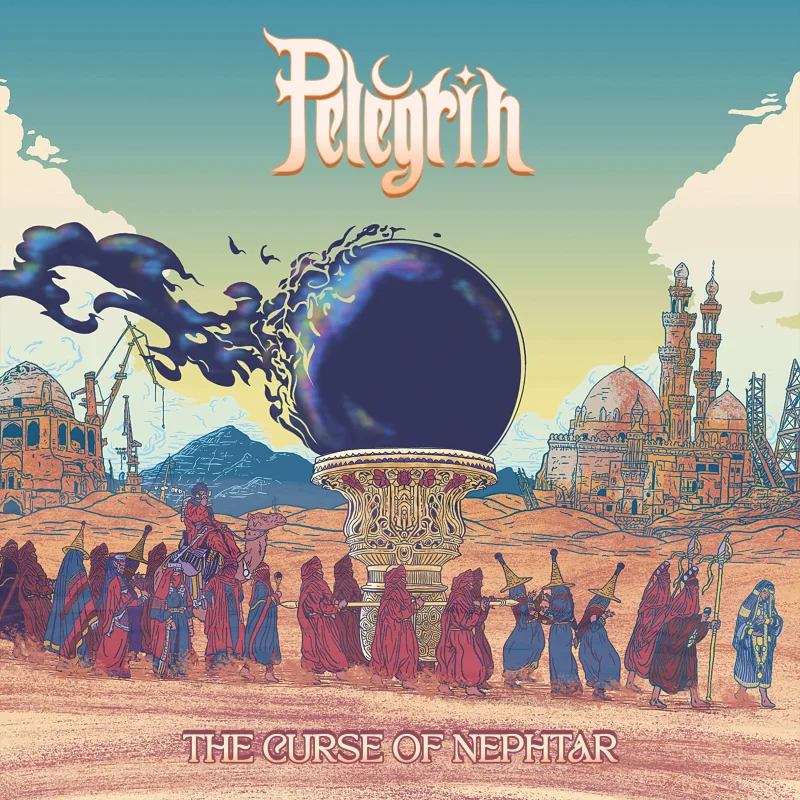
The French trio have been around since Al-Mahruqa and Ways of Avicenna, gradually carving out their own corner between heavy psych, stoner rock and progressive rock. The Curse of Nephtar is their third full-length, and while the basic ingredients haven’t suddenly been thrown out the window, there is noticeably more purpose behind the songwriting this time around. The riffs hit harder, the hooks arrive sooner, and the psychedelic side is used less as an excuse to wander and more as a way of giving the songs somewhere else to go.
And then there is Nephtar.
According to the story, this mysterious black orb has been sitting around in the prehistoric Tethys Ocean for an absurd amount of time before eventually reaching humanity and promising something that sounds very familiar: plenty. Wealth. Energy. Progress. Naturally, things don’t work out particularly well. The whole thing is essentially a psychedelic monster story built around the resource curse and the destructive consequences of fossil-fuel wealth, particularly in the Middle East.
On paper, that could have gone horribly wrong.
It doesn’t.
The reason is that Pelegrin don’t turn The Curse of Nephtar into a lecture. The concept sits underneath the music rather than constantly standing in front of it waving a flag. Spoken passages, strange noises and other pieces of sound design help connect the individual chapters, but you can completely ignore the mythology and still have a damn good heavy-psych record in front of you.
“Eons” is a good example of how they approach it. Rather than immediately throwing the biggest riff at you, the album takes its time getting started, creating that feeling of something ancient slowly coming back to the surface. Then “Sun and Blood” changes the temperature. The bass takes a much more noticeable role, the drums lock everything into place and the guitar starts doing what Pelegrin do best: finding the line between a riff that is heavy enough to satisfy the stoner crowd and a melody that actually stays in your head.
That balance is probably the strongest thing about the album.
“In the Company of Stars” opens things up again, bringing in a more spacious, almost desert-like atmosphere and some Eastern coloration without turning the whole thing into a collection of obvious exotic clichés. There is a lot happening around the central riffs, but it never feels as though the band are adding strange elements simply because a psychedelic/progressive record is supposed to have them.
Then “Drawn to Nephtar” brings the weight back.
This is where the concept and the music really start working together. The bass has that bubbling, slightly uneasy presence underneath the guitars, while the song gradually becomes heavier without needing to resort to some giant dramatic “LOOK, HERE COMES THE HEAVY PART” moment. The record understands something that plenty of bands in this scene occasionally forget: heaviness doesn’t always come from playing slower or adding more distortion. Sometimes it’s simply about letting a riff hang around long enough for it to become uncomfortable.
“Plenty” is probably the most immediately accessible piece of the record, and that’s not meant as a criticism. There is a groove here that doesn’t require any explanation of the Nephtar mythology, the Tethys Ocean or resource economics. You can just put the thing on and let it roll.
And then comes “The Price to Pay”.
The title obviously tells you where the story is heading, but the music does more than simply illustrate the lyrics. The track moves between heavier passages and more open melodic sections, with the guitar getting plenty of room before the rhythm pulls everything back together. It’s one of those moments where the progressive side of Pelegrin works because it serves the song rather than the musicians’ ego.
That’s an important distinction.
There is no shortage of bands capable of making a nine-minute psychedelic/progressive track that sounds impressive for nine minutes and leaves absolutely nothing behind afterwards. Pelegrin are more interested in making the journey itself memorable.
The closing “Break the Omen” takes the longest route, stretching out to nearly ten minutes. By this point the album has already established its vocabulary, so the track doesn’t need to introduce another dozen ideas. Instead it feels like the aftermath. The atmosphere becomes more haunted, the melodies carry more weight and the whole thing has the slightly uncomfortable sensation of something that isn’t really ending so much as disappearing over the horizon.
That works surprisingly well for a record about consequences.
And while the press material naturally throws around names like Elder, OM and Colour Haze, The Curse of Nephtar doesn’t strike me as a band desperately trying to sound like any of them. You can hear the same broad musical language, obviously, but Pelegrin have enough personality in the arrangements to avoid becoming another “insert your favourite heavy-psych band here” proposition.
If anything, the biggest improvement is that the songs themselves seem more confident.
There are still plenty of atmospheric passages, progressive detours and psychedelic breathing spaces, but the band seem less interested in proving how far they can stretch a composition. The riffs matter. The melodies matter. The groove matters. And when they finally let a section expand, you’ve already been given enough reason to follow it.
That’s what makes The Curse of Nephtar work.
You don’t need to read the story first. You don’t need to know anything about the resource curse. You don’t even need to particularly care about concept albums. Put the record on and there’s enough fuzz, weight, melody and movement to keep the thing alive on its own.
But if you do pay attention to what they’re saying, the album becomes considerably darker.
Because Nephtar isn’t really the monster here.
The monster is the promise.
The promise that there is always another resource to exploit, another fortune to make, another piece of ground to dig up and another convenient way of pretending that somebody else will deal with the consequences.
Pelegrin turn that idea into a pretty damn enjoyable heavy-psych trip.
Just don’t expect the trip to leave you in a particularly comfortable place.
Follow Pelegrin on Facebook
Released by Ripple Music on September 4th, 2026