
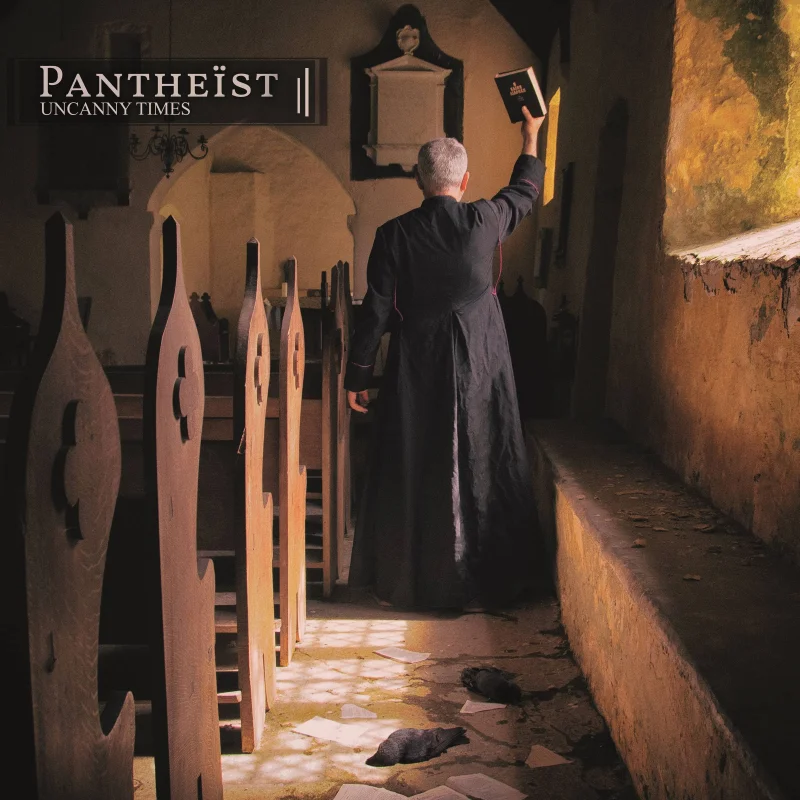
There is a lot going on beneath the surface of Uncanny Times, and not all of it becomes apparent on the first listen. Pantheist have never been a band particularly interested in making things easy for their audience, but this seventh full-length is especially rewarding when you pay attention to the details. The familiar funeral doom foundations are still there, although the album isn’t quite as uniform as one might expect from a record in this style.
Kostas Panagiotou founded Pantheist in Antwerp back in 2000, initially as a solo project. Since then, the band has gone through several changes of location and personnel, eventually settling in Cardiff. Their name has become well established among followers of atmospheric and funeral doom, with early material such as O Solitude still holding an important place in the band’s history. Sharing stages with Esoteric, Skepticism, Evoken and Saturnus also says something about the company they’ve kept over the years. Uncanny Times marks their first release for Argonauta Records, but there is no obvious attempt to make a fresh start here. This is very much Pantheist continuing along their own path.
One of the more interesting details behind the album is that a central piece remained unfinished for fifteen years. That’s quite a stretch of time for any composition, and it gives some context to the amount of thought that has gone into the material. The album also draws on a fairly unusual collection of ideas: the uncanny, mortality, the exhaustion caused by prolonged suffering, journeys without a proper destination and the gradual breakdown of familiar structures. Field recordings from Panama, references to Japanese folklore and echoes of Homer’s work all find their way into the record. Fortunately, these aren’t presented as a collection of intellectual talking points. They form part of the album’s wider subject matter without constantly demanding attention.
Musically, Uncanny Times remains firmly within funeral doom, but there is more to it than slow guitars and mournful keyboards. The downtuned riffs provide plenty of weight, while organ and piano bring a church-like quality to several passages. The rhythm section is restrained, as it needs to be, but the arrangements aren’t simply built around repeating the same slow movement for ten minutes. There are changes in pace, more agile passages and occasional folk influences. Additional contributions from guest musicians, including cello, extra guitar leads and traditional instruments, give certain sections a different character. They don’t always make the music lighter, but they do add some welcome variation.
The strongest moments come when these different elements are allowed to work together. The heavier passages have enough substance to avoid becoming background drone, while the quieter arrangements aren’t merely there to provide a break before the next slow riff. At times, the classical and liturgical touches are particularly effective. There are also sections where the compositions could probably have been trimmed a little. Funeral doom doesn’t need to be short, of course, but length alone doesn’t make every passage more convincing, and a few stretches here test the patience more than they justify it.
Still, there’s plenty to appreciate across the album. Pantheist understand the genre well enough to avoid relying entirely on its usual tricks, and the additional musical details give Uncanny Times more character than a straightforward exercise in misery and slow-motion heaviness. It isn’t a radical departure from what the band has done before, nor does it need to be. After more than two decades, they have a recognisable approach, and this record gives them another opportunity to develop it. Not everything works equally well, but there’s enough substance here to make the album worthwhile for anyone with an interest in the more adventurous side of funeral doom.
Follow Pantheist on Facebook
Released by Argonauta Records on October 30, 2026
Music source for review – Grand Sounds PR