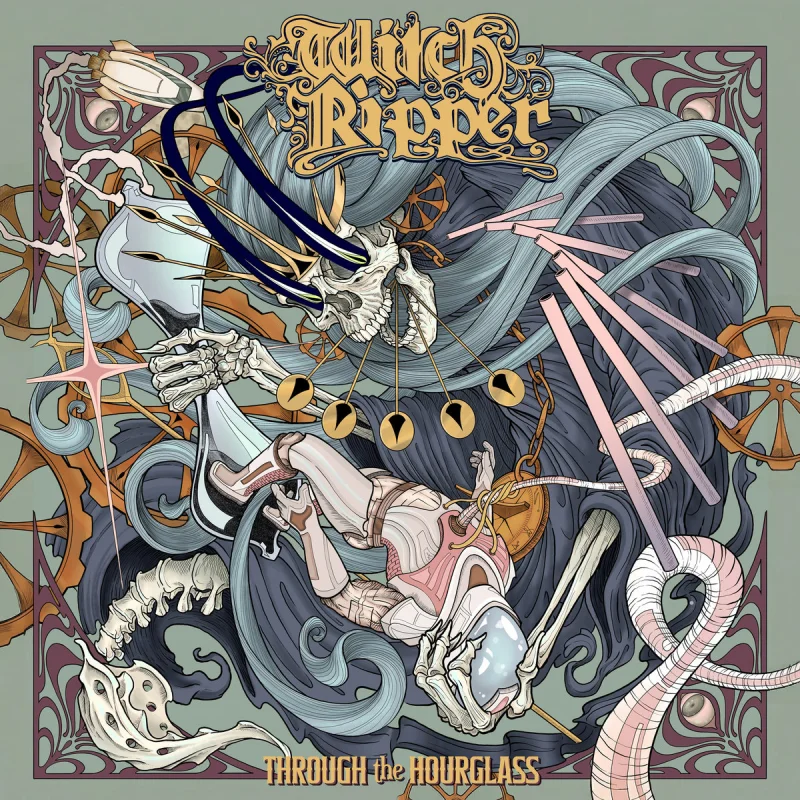
There was always more to WITCH RIPPER than the sludge tag suggested. The Seattle quartet started out heavier and rougher, but HOMESTEAD already showed a band that wasn’t particularly interested in staying in one lane. THE FLIGHT AFTER THE FALL pushed the progressive side further. THROUGH THE HOURGLASS continues that move, although the biggest change this time is how much melody they are willing to put right in the middle of the songs.
“Odyssey in Retrograde” is a short instrumental opener and can easily be treated as an introduction rather than a song in its own right. “The Portal” is where the album really begins. The guitars are thick, but the first thing that stands out is the amount of melody. Clean vocals are no longer just something dropped into a heavy passage for contrast. They have become part of the band’s normal vocabulary.
“Symmetry of the Hourglass” is probably the best example. There’s a chunky riff underneath it, but the chorus and guitar work are what stay in the head afterwards. The song doesn’t need a pile of technical tricks to keep things moving. A good riff arrives, another one answers it, the vocals give it a hook, and the whole thing works.
Then comes “Echoes and Dust”, and this is where the record really gets going. The groove is heavier, Joe Eck’s drumming has more punch, and the guitars have that combination of weight and melody that WITCH RIPPER seem to have been chasing. There are plenty of details to pick out, but the song doesn’t feel overloaded. It simply has a lot going for it.
The problem is that the album spends quite a bit of time around the same speed. “The Portal”, “Symmetry of the Hourglass” and “Echoes and Dust” are all good songs, but hearing three fairly deliberate, mid-tempo pieces in succession does flatten the album’s momentum a little. WITCH RIPPER change the riffs and arrangements rather than the pace. That works up to a point. I found myself wanting one proper kick in the teeth somewhere in the first half.
“The Clock Queen” has the riff for it. It’s one of the heaviest cuts here, with a nasty vocal performance and enough guitar work to fill its eight-plus minutes. It also illustrates another issue with the album: WITCH RIPPER sometimes have trouble deciding when a good idea has done its job. There are sections here that could have been shortened without taking anything important away. The song is good; it just doesn’t need quite as much of itself.
“Proxima Centauri” is a much better use of the band’s sense of space. Clean guitar, clean vocals and a slower, more fragile arrangement make the song stand out immediately. It also shows why the expanded vocal approach works. Chad Fox’s cleaner singing isn’t flawless, and some of the higher notes sound pushed, but there’s character in it. The imperfections are less distracting than they would be if he were trying to sound polished.
“The Spiral Eye” takes another step away from the straightforward riffing, with Irene Barber’s vocals adding a distant, almost floating layer to the song. Some of the heavier sections hit hard, and the contrast is effective. The trouble is again the length. The song has enough good material for a strong closer, but some of the repetition makes it feel as though WITCH RIPPER are reluctant to leave the room.
That’s probably the one thing I’d have changed on THROUGH THE HOURGLASS: edit it harder. The band clearly have no shortage of ideas. Quite the opposite. There are riffs, vocal parts, guitar harmonies and little arrangement changes everywhere. Sometimes the best thing they could do would be to remove one of them.
That criticism shouldn’t hide how much the band have improved. The older sludge foundation is still there, but WITCH RIPPER are much more comfortable with melody now. The classic-rock influence also makes sense because it shows up in the actual songwriting rather than as a collection of retro sounds pasted over metal riffs. There are moments where Mastodon and Baroness are obvious reference points, but WITCH RIPPER have enough of their own personality by now that the comparisons don’t define the record.
The science-fiction story running through the album helps give all of this a common thread, too. You don’t need to follow the narrative to enjoy the music, but the idea suits a band that keeps moving between heavy riffs, cleaner vocals and more spacious arrangements.
THROUGH THE HOURGLASS isn’t perfect, and I wouldn’t want it to be. The pacing could be more varied, a couple of songs could lose a minute or two, and some of the longer sections don’t earn their full length. But there is plenty here worth coming back to: “Symmetry of the Hourglass” has the hooks, “Echoes and Dust” has the muscle, “Proxima Centauri” shows another side of the band, and “The Spiral Eye” proves they’re willing to take some chances.
WITCH RIPPER are still a heavy band. They’re just not content with being only that anymore.
Follow WITCH RIPPER on Facebook
Released by Magnetic Eye Records on April 10, 2026