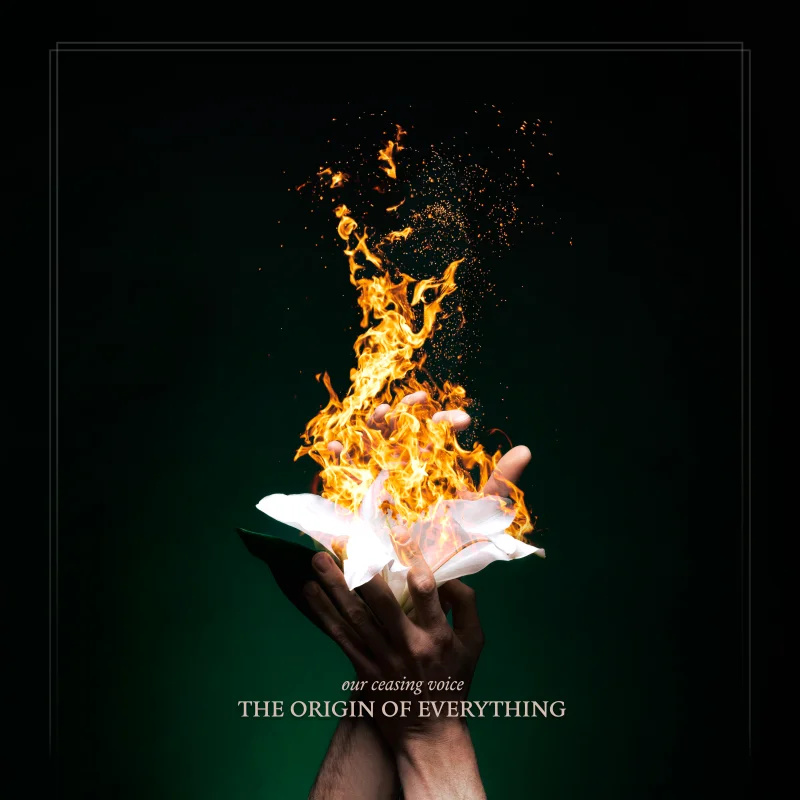
Twenty years as a band, four full-length albums, and enough long breaks to make that anniversary feel a little questionable even to the people celebrating it. Our Ceasing Voice have never been the most predictable outfit, and The Origin of Everything comes after another stretch of silence, with songs rescued from abandoned sessions and newer material written after life had taken the members in different directions. You can hear the appeal of that background before even getting into the music: this isn’t a band picking up exactly where it left off, because nobody really stays the same after that much time.
Dominik Dörfler’s deep, rough voice is a major part of the record’s identity. It sits somewhere between singing and speaking, giving the songs a grounded, almost conversational quality that changes the way the heavier passages land. There’s a risk with that kind of delivery, of course. When the voice takes up so much space, the music behind it needs to do more than simply swell whenever a chorus comes around. Our Ceasing Voice don’t always escape that trap, but the album has a few moments where they find something considerably stranger than the familiar quiet-verse/loud-chorus routine.
“Where I Belong” is a good example. At barely two minutes, it doesn’t hang around to explain itself; its dark, low-end-heavy sound makes it feel like a sudden drop into a basement halfway through the record. It’s the kind of interruption that makes you pay attention again. Rather than stretching an idea into another grand post-rock passage, the band get in, leave their mark and get out. I wish they trusted that instinct more often.
The contrast between “The Great Beyond” and “The Great Beyond (Reprise)” is another of the album’s more interesting decisions. The first strips away much of the usual band arrangement, leaving the voice suspended over a sparse electronic backdrop. The reprise brings the heavier instrumentation back into the picture, changing the same basic idea rather than simply repeating it. Heard together, the pair make a stronger case for the band’s range than another run of carefully arranged crescendos would have done. The placement also gives the album a natural break in its flow, a moment to step outside the established sound before returning to it from another direction.
Elsewhere, The Origin of Everything is less convincing when it settles into its more conventional post-metal mode. “June”, “Simplify”, “Diamond Eyes” and “Gasoline” apparently share a similar dynamic, moving from restrained passages into heavier, more forceful sections. There’s nothing wrong with that approach in itself, and it’s been part of this music’s vocabulary for decades. The trouble is that these songs don’t seem to leave as strong an impression as the material that takes a risk or changes the rules. When the album returns to that familiar pattern, the more unusual moments begin to look like exceptions rather than signs of where the band might go next.
“The Exit Wound Blues” closes things on a much more personal note. Built around clean guitar, a low drone and Dörfler’s voice, it leaves little to hide behind. The story of its creation gives it extra weight: Sebastian Obermeir wrote much of the lyric while thinking about his family, his son and his own childhood, and the song changed again when another person put those words into his mouth. That is a compelling idea in itself — private memories becoming something shared — and it fits an album assembled from different periods in the lives of the people involved.
The history behind The Origin of Everything is worth knowing, but it shouldn’t have to do all the heavy lifting. A long gap between albums doesn’t automatically make a return meaningful, and personal lyrics aren’t enough on their own to make a song work. What gives this record its strongest moments is the willingness to strip things back, darken the sound or let a piece of music stand apart from the band’s more familiar arrangements. Those moments suggest that Our Ceasing Voice still have unexplored territory in front of them, even after two decades of starting over.
For me, the most promising part of this album is the space between what Our Ceasing Voice have become known for and what they seem capable of doing when they leave that sound behind. The Origin of Everything doesn’t need to abandon post-rock or post-metal altogether, but the unusual pieces make the strongest argument for the band’s next chapter. After all these years, I’d rather hear them follow those detours than spend another album proving they can still build a heavy chorus.
Follow Our Ceasing Voice on Facebook
Released by Argonauta Records on October 2nd, 2026
Music source for review – Grand Sounds PR